
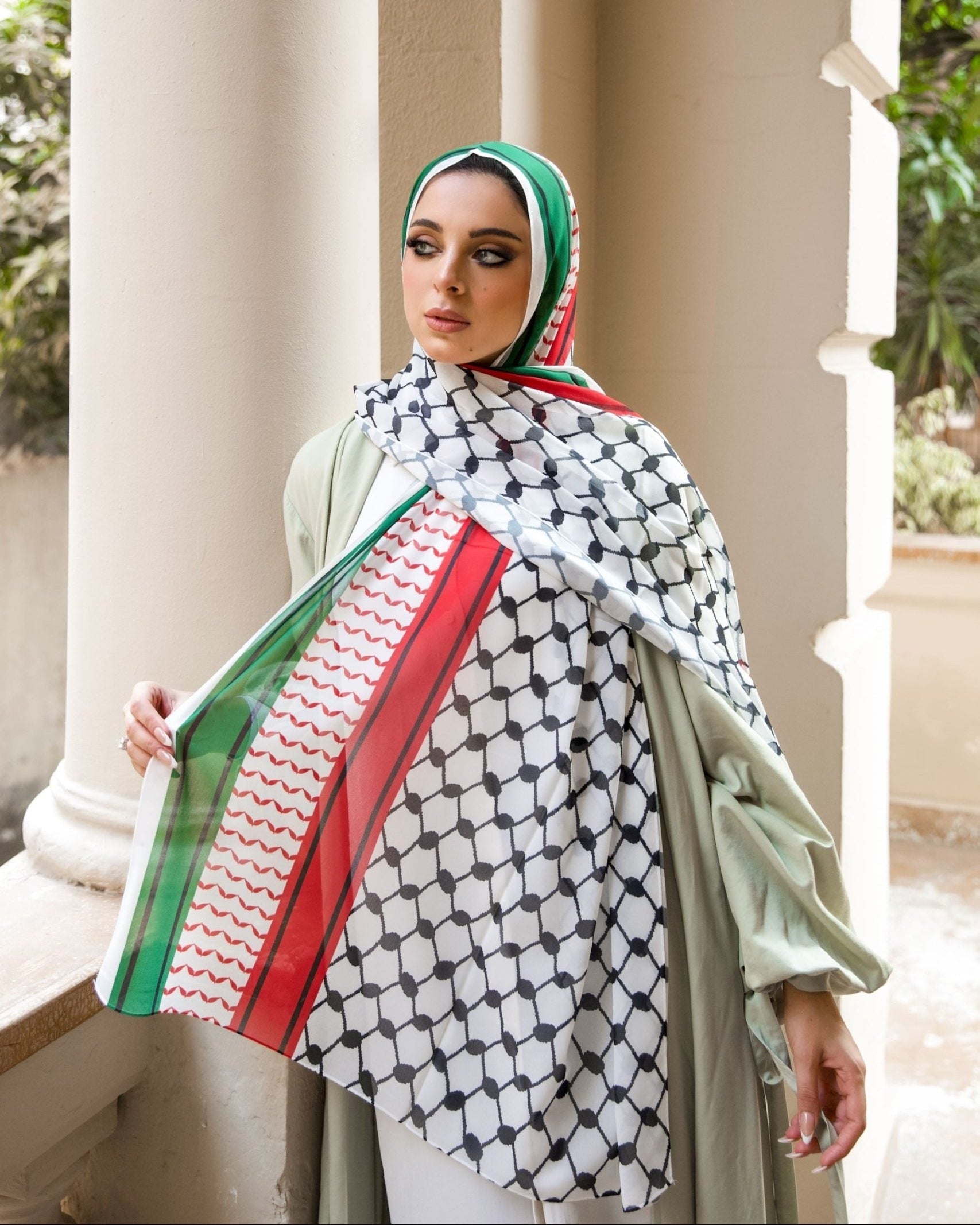
What Does the Keffiyeh Pattern Mean? A Cultural Guide
The keffiyeh is a traditional woven cotton scarf from the Middle East, and in Palestine the black-and-white version became a national symbol. Its pattern is most commonly read as three motifs: a fishnet for the sea, olive leaves for the land, and bold lines for the trade routes that crossed it.
See the pattern on a chiffon design

Jabalia Veil – Luxury Chiffon Hijab
A chiffon scarf featuring a keffiyeh-inspired design.
View product →That's the short answer. The longer story — how a farmer's sun scarf became one of the most recognized symbols in the world — deserves telling properly. This is a cultural guide, written with care.
What Is a Keffiyeh?
The keffiyeh — also called a kufiya, hatta, or shemagh depending on the region — is a square cotton scarf woven with a distinctive checkered pattern. For generations it was practical before it was symbolic: farmers and shepherds across the Levant wore it to shield their heads from the summer sun and the winter wind.
In Palestine, it was above all the garment of the fellahin — the village farmers — long before it meant anything more.
How a Farmer's Scarf Became a National Symbol
The turning point came during the Arab Revolt of 1936 to 1939. Fighters wore the keffiyeh to shield their identities, and when the British authorities tried to ban it, something remarkable happened: Palestinians across every class began wearing it together. City dwellers set aside the tarbush — the formal urban hat of the era — and tied on the farmer's scarf instead, so that no one wearing it could be singled out.
A piece of working clothing became a statement of unity. From the late 1960s onward, the black-and-white keffiyeh grew into a symbol recognized far beyond the region — carried by the diaspora, worn in solidarity, and photographed on every continent.
What the Pattern Is Said to Mean
The keffiyeh's woven pattern holds three motifs, and the reading passed from generation to generation goes like this:
- The fishnet — the grid of interlocking lines at the centre — is read as the fishing nets of the Mediterranean coast, and the connection between the people and their sea.
- The olive leaves along the borders are read as the olive tree: the land itself, and the patience and perseverance of the people who tend it.
- The bold lines running through the cloth are read as the trade routes — the long history of travel, exchange, and connection that crossed Palestine for centuries.
An honest note: these readings live in the telling. They have been shared from parent to child and weaver to wearer rather than written down in a single documented origin — which is, in its own way, exactly how the meaning of cloth has always travelled.
Black and White, Red and White
The black-and-white keffiyeh is the one bound to Palestine. The red-and-white version comes from the same family of woven scarves and is traditionally worn across Jordan and the Gulf. Both are authentic to the region; history simply gave the black-and-white pattern its Palestinian meaning.
Where Authentic Keffiyehs Are Made Today
Most keffiyehs sold around the world today are mass-produced abroad. In Palestine itself, one factory remains: Hirbawi, weaving in Hebron since 1961, is the last keffiyeh factory in the country — a family business that kept its looms running while every other local maker closed. If owning a keffiyeh woven in Palestine matters to you, that is where the real ones come from, and supporting them supports the craft staying alive at its source.
Wearing the Pattern with Understanding
A pattern that carries this much history deserves to be worn knowingly. That is the spirit behind the Jabalia Veil in our Palestine Edit — a luxury chiffon hijab carrying an original illustrated keffiyeh-inspired print. It is not a woven keffiyeh, and we would never claim it is. It is a hijab designed to honour the pattern and the story it holds, for wearers who want to carry both.

From the Palestine Edit
Jabalia Veil – Luxury Chiffon Hijab
An original keffiyeh-inspired print on breathable luxury chiffon — designed to honour the pattern and carry its story with dignity.
See the Jabalia Veil →Frequently Asked Questions
What does the keffiyeh symbolize?
The keffiyeh symbolizes Palestinian identity, unity, and connection to the land. It began as a practical farmer's scarf, became a symbol of national unity during the Arab Revolt of 1936 to 1939, and has since grown into a globally recognized emblem of Palestinian heritage and solidarity.
What do the patterns on a keffiyeh mean?
The most widely shared reading names three motifs: the fishnet centre for the Mediterranean sea and its fishermen, the olive-leaf borders for the land and the perseverance of its people, and the bold lines for the historic trade routes that crossed Palestine. These meanings have been passed down through generations of telling.
Why is the Palestinian keffiyeh black and white?
The black-and-white pattern is the version history tied to Palestine, worn en masse from the 1930s onward as a statement of unity. The red-and-white keffiyeh comes from the same family of scarves and is traditionally associated with Jordan and the Gulf.
Where are authentic Palestinian keffiyehs made?
The last keffiyeh factory in Palestine is Hirbawi, which has been weaving in Hebron since 1961. Most keffiyehs sold worldwide today are manufactured abroad, so provenance is worth checking if a Palestinian-made scarf matters to you.
Is it respectful to wear keffiyeh-inspired pieces?
Wearing the pattern with understanding is what matters: knowing its history, honouring what it carries, and supporting Palestinian makers where you can. A keffiyeh-inspired piece worn knowingly is a way of carrying the story; the disrespect lies in wearing it emptied of meaning.
If you'd like to learn the related tradition of Palestinian embroidery, our guide to what tatreez is continues the story in thread.
Questions about the Jabalia Veil or the stories behind our prints? DM us @myjaida. 🤍

Leave a comment
This site is protected by hCaptcha and the hCaptcha Privacy Policy and Terms of Service apply.