


Hair Care Under Hijab: The Complete Routine for Healthy Hair, Scalp & Hairline (2026 Guide)
Healthy hair under hijab comes down to four habits: let your scalp breathe daily, never wrap wet or damp hair, choose breathable fabric underscarves (silk, modal cotton, bamboo), and oil your scalp 2–3 times a week. Hair loss, breakage, and scalp issues under hijab are almost always traceable to one of these four habits being skipped — not to hijab itself.
One of the most-searched questions from hijabis is how to keep hair healthy while covering it every day. The myth that hijab causes hair loss has been around forever. The truth is more nuanced: hijab doesn't damage hair, but certain habits common among hijabis do. This guide breaks down the science, the daily routine, and the products and accessories that actually protect your hair under hijab.
Does wearing hijab cause hair loss?
No — hijab itself does not cause hair loss. What can cause hair loss is the combination of habits that often accompany wearing hijab: pulling hair into tight buns, wrapping wet or damp hair, friction from synthetic fabrics, scalp not breathing for 12+ hours a day, and overlooking scalp health because the hair isn't visible.
Studies on hair loss (alopecia) in hijabi women consistently identify traction alopecia (caused by tight hairstyles, not the hijab itself) and scalp folliculitis (caused by trapped moisture and lack of airflow) as the two most common culprits. Both are preventable.
The 4-pillar healthy hair routine for hijabis
Pillar 1: Let your scalp breathe
The single most important habit. Your scalp needs at least 2–3 hours of uncovered airflow daily — ideally first thing in the morning and last thing at night. Trapped warmth and moisture under a hijab create conditions for fungal growth, dandruff, oily roots, and follicle weakness.
- Take your hijab off as soon as you're in a private space — don't sit in it all evening at home.
- Brush your hair gently morning and night to stimulate the scalp.
- On weekends and at home, give your hair extended uncovered time.
Pillar 2: Never wrap wet or damp hair
This is the #1 mistake hijabis make. Wet hair under a hijab traps moisture against the scalp for hours, creating the ideal environment for:
- Fungal scalp infections (dandruff, ringworm)
- Bacterial folliculitis (red bumps and inflammation)
- Hair breakage — wet hair is at its weakest, and friction breaks it
- Persistent dampness that smells musty by midday
The fix: Always blow-dry your hair completely (cool or low heat) before wrapping. If you wash your hair in the morning, give yourself the extra 10 minutes. If you wash at night, sleep on it and let it air-dry.
Pillar 3: Choose breathable underscarf fabric
The underscarf sits directly against your scalp for 12+ hours a day. Synthetic underscarves (cheap polyester, slick nylon) trap heat, cause friction breakage, and don't let moisture evaporate.
The best underscarf fabrics for hair health:
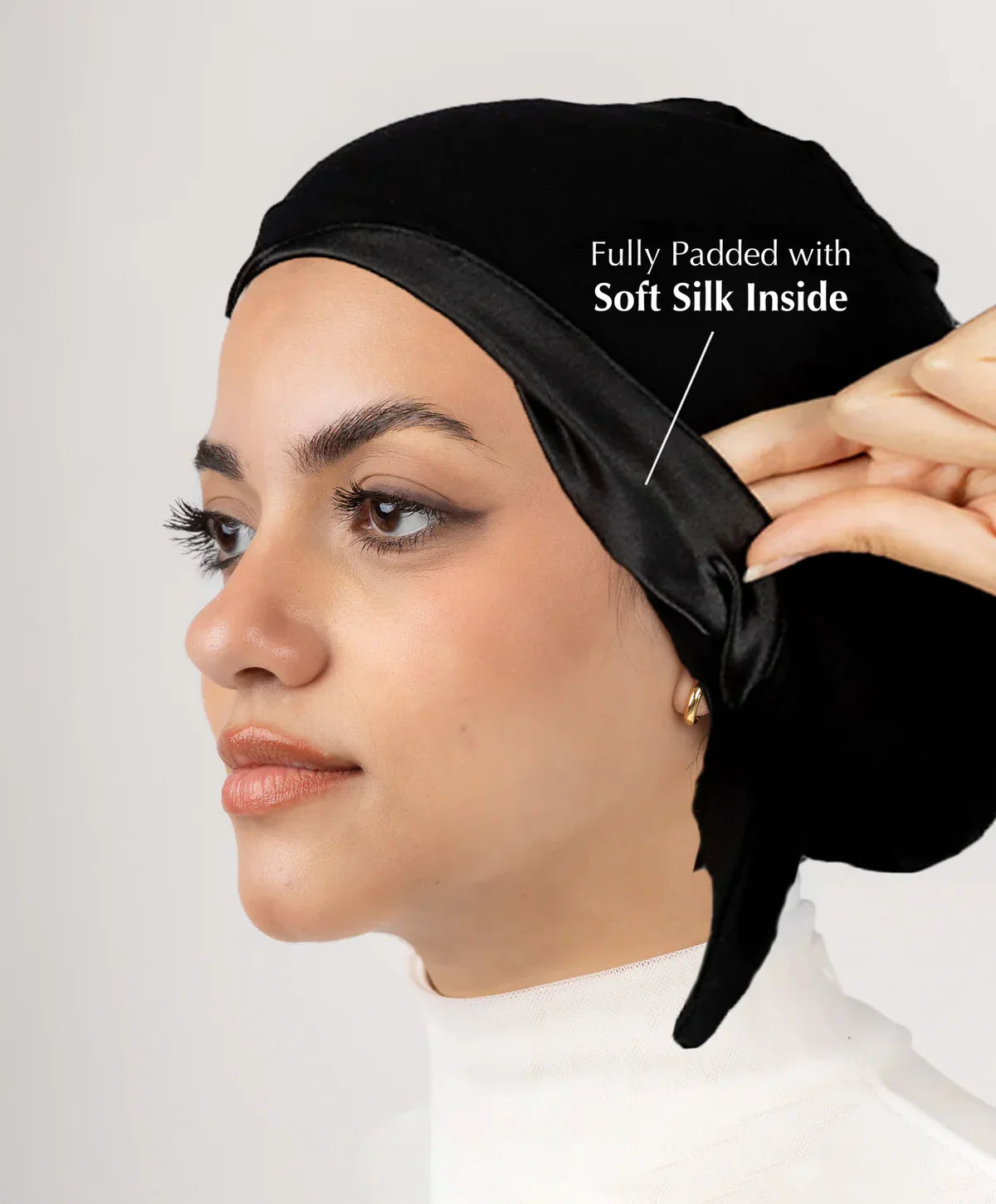
- Silk-feel matte fabric — the gentlest on hair strands, reduces friction breakage. The JAIDA Inner Silk Underscarf is designed for this — matte silk that grips chiffon without pulling on hair.
- Modal cotton — breathable, soft, naturally cool. The No-Thread Seamless Underscarf uses a modal-blend fabric.
- Bamboo blends — naturally antibacterial and moisture-wicking.
Avoid: polyester underscarves that feel slick and synthetic, tight elastic underscarves that pull at the hairline, anything that creates a sweaty feeling within an hour of wearing it.

From the JAIDA Collection
Inner Silk Undercap
Silk-touch on the inside, so your strands and edges glide instead of snag. Grippy cotton on the outside, so your hijab stays put. Built for exactly this routine.
See the Inner Silk Undercap →Pillar 4: Oil your scalp 2–3 times a week
Scalp oiling is the single most effective habit for hijabi hair health, and the most overlooked. Massaging oil into your scalp 2–3 times a week:
- Stimulates blood flow to the follicles (encourages growth)
- Conditions the scalp so it doesn't dry out from being covered
- Strengthens the hair at the root
- Reduces breakage and shedding
- Helps with dandruff and dry scalp
The best oils for hijabi hair:
- Castor oil — the gold standard for thickness and growth. Heavy, so use 2–3 drops max.
- Argan oil — lightweight, great for shine and softness.
- Jojoba oil — closest to your scalp's natural sebum, ideal for daily-ish use.
- Rosemary oil — clinically shown to help with hair density (mix with a carrier oil).
- Coconut oil — great for the hair shaft, but use sparingly on the scalp if you're acne-prone.
The routine: Apply oil to your scalp in the evening, massage for 5–10 minutes, leave it in overnight or for at least 2 hours, then wash it out. Do this 2–3 times a week.
The hairstyles to wear (and avoid) under hijab
Hairstyles that protect your hair under hijab
- Loose low bun — secured at the nape, no tension on the hairline.
- Loose braid — single or double, gentle on the hair, no friction.
- Loose twist — wrapped low and secured with a soft scrunchie.
- Hair down (if your hair is short) — brushed and smoothed under the underscarf.
Hairstyles that damage your hair under hijab
- Tight high ponytails — the leading cause of traction alopecia at the hairline.
- Tight high buns — same problem, pulled even tighter to fit under the hijab.
- Hair tied with thin elastic bands — cause breakage where the band touches.
- Wet hair tied tightly — maximum damage scenario.
The fix: Switch to silk or satin scrunchies. Tie your hair at the nape, not the crown. Keep the tension loose enough that you can easily slide a finger under the elastic.
How often should I wash my hair when wearing hijab?
There's no universal answer — it depends on your hair type, scalp oiliness, and climate. General guidance:
- Oily scalp: 3–4 times a week. Lather only at the scalp, not the lengths.
- Normal scalp: 2–3 times a week.
- Dry scalp: 1–2 times a week, with deep conditioning between washes.
- Curly or textured hair: Co-wash (conditioner only) 1–2 times a week, full wash 1 time a week.
The key is consistency — a clean scalp every few days is better for hair health than washing daily or letting buildup accumulate for a week.
Common hair problems under hijab and how to fix them
Problem: Hairline breakage / receding hairline
Cause: Friction from the underscarf, tight pinning at the temples, tight ponytails or buns that pull the hairline.
Fix: Switch to a silk-feel underscarf (less friction), loosen your hairstyle, oil the hairline 2–3 times a week with castor or rosemary oil.
Problem: Oily roots by midday
Cause: Heat trapped under the hijab stimulates oil production.
Fix: Breathable underscarf fabric (modal, bamboo, silk), give your scalp uncovered time in the morning, dry shampoo at the roots before wrapping if needed.
Problem: Dandruff or flaky scalp
Cause: Trapped moisture, fungal overgrowth (very common under hijab), or scalp dryness.
Fix: Never wrap damp hair, use an anti-fungal shampoo (Nizoral 1–2x weekly), apply rosemary or tea tree oil to the scalp.
Problem: Hair shedding more than usual
Cause: Could be tight hairstyles, low iron/vitamin D, stress, or postpartum (if applicable).
Fix: Loosen hairstyles immediately, check your iron and vitamin D levels with bloodwork, scalp-oil 2–3 times a week. If shedding persists more than 3 months, see a dermatologist.
Problem: Hair feels weighed down and flat
Cause: Product buildup or over-oiling.
Fix: Clarifying shampoo once every 2 weeks. Reduce oil to 2 times a week.
Problem: Scalp itches at the end of the day
Cause: Synthetic underscarf, sweat buildup, or product residue.
Fix: Switch to a breathable underscarf (modal cotton or silk-feel), wash your hair more frequently, take longer scalp-breathing breaks.
The hijabi hair care routine in 5 minutes a day
Morning (3 minutes):
- Brush hair gently for 30 seconds to stimulate scalp.
- If your hair feels oily, apply a tiny bit of dry shampoo at the roots.
- Tie hair loosely at the nape with a silk scrunchie.
- Put on your breathable underscarf.
Evening (2 minutes):
- Take off your hijab and underscarf as soon as you're home.
- Brush your scalp for 1–2 minutes (boar bristle brushes are ideal).
- Let your hair breathe uncovered for at least an hour before bed.
2–3 times a week (10 minutes):
- Apply scalp oil and massage for 5–10 minutes.
- Leave overnight or for at least 2 hours.
- Wash out with your usual shampoo.
What about hair growth?
Hijabis often worry about whether covering hair slows growth. It doesn't. Hair grows from inside the follicle — covered or uncovered makes no difference to growth rate (about 1.25 cm per month on average).
What can slow visible growth: breakage at the ends, which makes hair appear to stop growing even though it's still growing at the root. Healthy ends + healthy scalp = visible growth. The four pillars above protect both.
Frequently asked
Does wearing hijab cause hair loss?
No. Hijab itself doesn't cause hair loss. Habits that often accompany wearing hijab — tight hairstyles, wrapping wet hair, synthetic underscarves, and not letting the scalp breathe — can cause hair loss. All four are preventable.
Can I wash my hair every day if I wear hijab?
You can, but it's usually not necessary. Daily washing strips natural oils and can make the scalp produce more oil. 2–4 times a week is ideal for most hair types under hijab.
What's the best underscarf for healthy hair?
Silk-feel matte fabrics are gentlest on hair strands and reduce friction breakage. Modal cotton and bamboo blends are also excellent for breathability. Avoid synthetic polyester that traps heat and causes friction.
How long should I let my scalp breathe each day?
At least 2–3 hours of uncovered airflow daily. Ideally first thing in the morning and last thing at night.
Is it bad to sleep in my hijab?
Yes, generally. Sleeping in a full hijab wrap traps heat and moisture for another 7–8 hours on top of your daytime wear, which can stress the scalp. If you want to protect your hair while sleeping, use a satin sleep cap or sleep on a satin pillowcase instead.
What's the best oil for hijabi hair?
Castor oil for growth and thickness (use sparingly), argan oil for shine, jojoba oil for daily-ish use, rosemary oil for hair density (mix with a carrier), and coconut oil for the hair shaft. Most hijabis benefit from rotating two or three of these.
How do I stop my hairline from receding under hijab?
Switch to a silk-feel underscarf (less friction), loosen any tight hairstyle that pulls at the temples, and oil the hairline 2–3 times a week with castor or rosemary oil. If receding continues for 3+ months, see a dermatologist.
Why does my scalp feel itchy under my hijab?
Usually one of three causes: synthetic underscarf trapping heat, product buildup or sweat residue, or fungal scalp condition. Switch to breathable underscarf fabric, wash hair more frequently, and use an anti-fungal shampoo 1–2 times weekly if itching persists.
The bottom line
Healthy hair under hijab isn't complicated, but it does require intention. The hijabis with the healthiest hair aren't the ones who use the most expensive products — they're the ones who never wrap wet hair, choose breathable fabrics, oil their scalp consistently, and let their hair breathe for a few hours every day.
Start with the four pillars. Switch your underscarf to something breathable. The hair under your hijab is just as worth caring for as the hijab itself.
Designed in Canada by hijabis, for hijabis. Free 30-day returns on every order.
,%20and%20oil%20your%20scalp...)
Leave a comment
This site is protected by hCaptcha and the hCaptcha Privacy Policy and Terms of Service apply.